
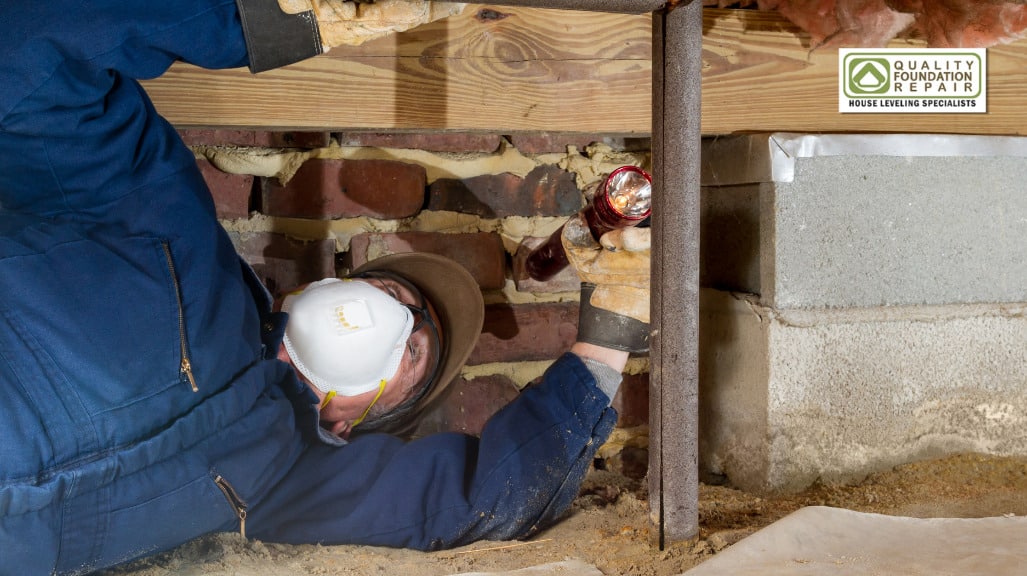
Your home's foundation is only as strong as the support beneath it. If your pier and beam foundation shows signs of sagging floors, uneven surfaces, or structural instability, your crawl space support system may be failing.
Crawl space support piers keep your home level and stable. They bear the weight of your structure, helping prevent shifts and settlement caused by moisture, soil movement, and aging materials. In this guide, we'll explain the common types of crawl space support piers you'll come across, how to tell when your home needs them, and which methods Quality Foundation Repair actually uses.
One note up front: for crawl space and pier and beam work, Quality Foundation Repair Austin uses the Adjust-A-Pier system, and for slab foundations we install our own in-house steel push piers. We do not install helical piers. A couple of the pier types below are included for context so you understand the full landscape, not because we install every one of them.
What Are Crawl Space Support Piers?
If you own a home with a pier and beam foundation, the support system beneath your house is crucial to keeping everything stable. Over time, you might notice sagging floors, sticking doors, or cracks in your walls, all signs that your foundation may not be as strong as it once was. Crawl space support piers act like sturdy legs holding up your home, evenly distributing weight and helping prevent structural shifts.
How Do Crawl Space Support Piers Keep Your Home Stable?
Think of your foundation like a table. If one leg starts to weaken, the whole surface becomes unstable. Crawl space support piers do the same job as sturdy table legs. They:
Reinforce weak or deteriorating beams so floors stop sagging.
Distribute your home's weight evenly so one side doesn't sink faster than the other.
Help counter soil movement, especially in Austin, where shifting clay soil can cause homes to settle unpredictably.
Common Types of Crawl Space Support Piers
Not all crawl space support piers are the same. Depending on foundation issues, soil conditions, and budget, different piers suit different situations. Here are the most common types.
Adjustable Steel Piers (Adjust-A-Pier System)
Best for: Homes needing future adjustments due to shifting soil or ongoing foundation movement. This is the system Quality Foundation Repair Austin uses for pier and beam and crawl space support.
Adjustable steel piers are a strong solution for homes built on unstable or expansive soil. They provide long-term support, and their key advantage is that they can be adjusted later if the foundation shifts again.
Benefits:
- Can be fine-tuned as needed, which helps avoid costly future repairs.
- Strong steel construction for durability and long-term stability.
- Well suited to high-movement soil areas like Austin, TX.
Potential downsides:
- More expensive than traditional concrete block piers.
- Requires expert installation for proper adjustment.
Concrete Block Piers
Best for: Budget-friendly support in low-moisture environments.
Concrete block piers are common in older pier and beam homes. They consist of stacked concrete blocks and wooden shims supporting the crawl space beams.
Benefits: Affordable compared to steel alternatives, and easy to use for minor leveling adjustments.
Potential downsides: Not adjustable once they settle, susceptible to shifting, cracking, or moisture damage over time, and generally less durable than steel piers.
Helical Piers
Best for: Deep stabilization in weak or unstable soil. Note: Quality Foundation Repair Austin does not install helical piers; this type is included for context.
Helical piers are designed like large screws that turn deep into the soil, offering high load capacity. Across the industry they are used for homes with loose, sandy, or clay-heavy soil.
Benefits often cited: Deep support to help prevent sinking, effective in soft or shifting soil, and usable for both new construction and repair.
Potential downsides: Higher installation cost than basic support piers, and they require a professional soil assessment.
Steel Push Piers
Best for: Homes experiencing long-term settlement or shifting soil. Quality Foundation Repair Austin manufactures and installs these in-house for slab foundations.
Steel push piers are driven deep into stable soil to provide strong foundation support. If your home has been sinking or settling unevenly, they may be the right solution.
Benefits: Strong, long-term support, effective in areas with unpredictable soil movement, and helpful in preventing future settlement.
Potential downsides: Requires professional installation to reach deep soil layers, and costs more than some options while lasting longer.
Hybrid Pier Systems
Best for: Custom solutions combining multiple pier types for extra support.
Some homes need a mix of steel, concrete, and adjustable piers to address unique foundation issues, placing different pier types in strategic locations under the home. Hybrid systems offer tailored solutions but are more complex and costly to install and require a foundation expert to design.
Crawl Space Jacks
Best for: Reinforcing sagging floors and minor foundation settlement.
If your home has sagging beams or weak floor joists, adjustable crawl space jacks can reinforce your foundation and are often used alongside a pier system. They are adjustable for future modifications, though on their own they may need periodic adjustment over time.
Signs You Need Crawl Space Support Piers
- Sloping or sagging floors: If floors feel uneven or furniture tilts, your crawl space may not be providing proper support.
- Cracks in drywall or sticking doors: Foundation shifts stress walls and door frames, leading to cracks and misaligned doors.
- Gaps between walls and floors: Gaps where walls meet the floor, or baseboards pulling away, can signal shifting.
- Excessive moisture or mold in the crawl space: Standing water, dampness, or mold can weaken wooden supports and lead to decay.
- Pest activity through structural gaps: Termites and rodents often enter through cracks or weakened crawl space structures.
Choosing the Right Support Piers for Your Home
The right choice depends on soil conditions, foundation issues, and budget.
Austin soil: Austin's expansive clay soil expands when wet and contracts when dry, causing foundations to shift. Because of that movement, adjustable piers and deep-set steel push piers are often better suited than concrete block piers, which can shift over time.
Adjustable vs. fixed: Adjustable piers such as the Adjust-A-Pier system are ideal for homes in shifting-soil areas because they allow future leveling. Fixed piers such as concrete block or steel push piers provide permanent-position support once set.
Cost: Concrete block piers and jacks are lower-cost options that may need more maintenance. Steel push piers and hybrid systems cost more upfront but provide long-term stability, which is often the better investment in high-movement soil.
Next Steps
If you're unsure which support approach is right for your home, schedule a free crawl space inspection with Quality Foundation Repair Austin. Our experts will evaluate your foundation and recommend the most cost-effective solution using the methods we install.
Protect Your Foundation With the Right Support
A strong, stable foundation is the key to a safe home. The right crawl space support helps prevent sagging floors, structural damage, and long-term foundation problems. If you're worried about your crawl space foundation, our team at Quality Foundation Repair Austin offers free crawl space inspections to assess your foundation's condition and recommend the best solution.