
Cracks in the wall. Floors that sag. Doors that stick like they have been welded shut.
These are not just quirks of an aging house, they are warning signs. In Austin and across Central Texas, foundation problems are about as common as summer heat, and the reason is underfoot: expansive clay soil that swells when wet and shrinks when dry, moving your foundation with it.
Foundation stabilization is how you stop that movement. Not cosmetically, structurally. Here is what it involves, what causes the problem in the first place, and how to tell whether your house is showing early signs.
What Is Foundation Stabilization?
Your house is only as stable as what it sits on. When the ground underneath moves, and in Central Texas it moves constantly, the structure above has to absorb it.
Stabilization means reinforcing the foundation so that soil movement stops translating into structural movement. Around Austin, our clay soils swell with rain and shrink through the summer drought. That back-and-forth cycle is what produces cracked walls, sloping floors, and doors that stop shutting properly.
Done properly, stabilization stops the progression. It does not always mean the house ends up perfectly flat, which is an important distinction we will come back to below.
Signs You May Need Foundation Stabilization
Most homes show symptoms well before the damage becomes serious. You just have to know what you are looking at.
Inside the House
- Cracks in drywall, particularly at the corners of door and window openings, where stress concentrates.
- Doors and windows that stick, swing open on their own, or no longer sit square in the frame.
- Uneven or sloping floors. If a dropped marble consistently rolls the same direction, that is worth investigating.
- Gaps opening between walls, ceilings, and floors, or trim separating at the joints.
- Tile or flooring cracks appearing in a line, which usually reflects a crack in the slab beneath.
Outside the House
- Stair-step cracks in brick or stone, following the mortar joints. A classic settlement pattern.
- Gaps around door frames, window frames, or fascia, showing that the structure has moved even where the glass has not cracked.
- Cracks in the slab edge or around the perimeter.
- A chimney pulling away from the house or visibly leaning.
- Soil pulling back from the foundation, leaving a visible gap after a dry spell.
None of these resolve on their own. They are the early, cheap stage of a problem that gets more expensive the longer it runs.
How We Stabilize a Foundation
Every house sits on its own soil profile with its own drainage situation, so the work starts with an inspection: what is moving, how far, and what is driving it. The repair plan follows from that rather than from a standard package.
Steel Push Piers, for Slab Foundations
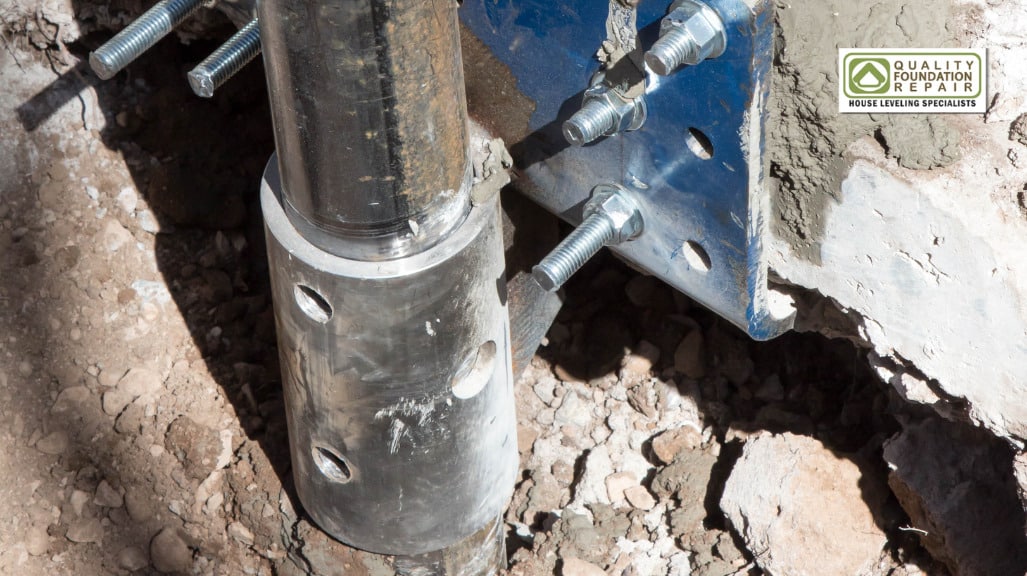
For a settling slab, we drive steel push piers through the unstable surface clay down to firm load-bearing strata. The piers transfer the weight of the house off the clay that is moving and onto soil that is not. A pressure gauge on the hydraulic press tells us when each pier has reached firm bearing.
We manufacture these piers in-house, which means we control the quality of the steel going under your home.
Adjust-A-Piers, for Pier-and-Beam Foundations
Under a pier-and-beam house we reinforce joists, replace beams that have rotted, and install Adjust-A-Piers for support. The advantage is in the name. Central Texas soil keeps moving after the repair is finished, and an adjustable pier can be brought back into position later without redoing the work.
Soil Stabilization
Where the soil itself is the problem, treating it to reduce how much it swells and shrinks makes the rest of the repair last longer. It is unglamorous work and it is often what separates a repair that holds from one that does not.
Drainage That Protects the Foundation
We go after the cause, not just the symptom, and around here the cause is usually water. That means correcting grade so water runs away from the house, extending downspouts, and installing crawl space drainage where a pier-and-beam home needs it. Dry soil is stable soil.
One note on scope, because homeowners ask. Quality Foundation Repair Austin handles the drainage work that protects a foundation. We do not install standalone French drains, and we do not do basement waterproofing systems. If your situation calls for one of those, we will tell you during the inspection rather than sell you something adjacent.
A Note on Helical Piers
Helical piers come up constantly in foundation research, so it is worth being direct: we do not install them. They are a legitimate industry method, essentially large screws turned into the ground with a hydraulic torque motor, and some companies build their work around them. We build ours around in-house steel push piers because they suit the expansive clay conditions across Central Texas and because we control their manufacture end to end.
What the Warranty Actually Covers
Warranty terms in this industry are often stated more simply than they really are, so here is exactly how ours works. Coverage is tied to the load-bearing pressure each pier reaches at installation:
- 8,000 psi and above: lifetime transferable warranty.
- 5,000 to 8,000 psi: five year warranty.
- Below 5,000 psi: no warranty on that pier.
Two conditions matter alongside those tiers. A slab warranty requires a passed hydrostatic plumbing test within 60 days of the repair, because an undetected plumbing leak will undo the work. And the warranty is void where adverse drainage conditions are present, which is another reason drainage is part of the conversation rather than an upsell after it.
Why Foundations Become Unstable
- Expansive clay soil. Central Texas clay swells with moisture and shrinks in drought, putting the foundation through a continuous cycle of pressure and release.
- Poor drainage. Water pooling near the foundation keeps the soil there saturated and soft while the rest of the perimeter dries out, which is exactly the uneven condition that causes differential settlement.
- Tree roots. Mature root systems pull moisture out of the soil under a foundation, shrinking it on one side of the house.
- Poor soil compaction. Sometimes the problem predates the house. Ground that was not compacted before the pour settles unevenly once the structure's weight is on it.
- Plumbing leaks. A leak under a slab erodes and saturates the soil quietly, sometimes for years, which is why the hydrostatic test is part of the process.
Stabilization Compared With Leveling
These get used interchangeably, but they are different jobs that often happen together.
Stabilization stops the movement. Piers and soil work lock the structure to ground that is not shifting, preventing further settlement. It does not necessarily return the house to flat.
Leveling lifts sections that have already dropped. It happens during stabilization when the structure can safely take the lift.
We aim for what we call maximum practical level: raising the house as far as it will safely go without causing new damage. Sometimes that is very close to flat. Sometimes it is enough to stop the problem and no further, because a house that has been settling for two decades has adjusted to its position, and forcing it all the way back cracks finishes and breaks pipes. We will tell you which situation yours is before any work starts.
Ready to Stop the Movement?
Cracks do not close on their own and floors do not level out overnight. If your home is showing the signs above, the useful next step is finding out what is actually causing them. Book a free foundation inspection and you will get a straight answer, including if that answer is that your house does not need work yet.