
Many homeowners hear the phrase "house leveling" and are not sure what it actually means, or whether their home needs it. This guide explains the basics: why foundations move in Central Texas, what leveling involves on the two foundation types we see around Austin, and when the problem has gone past anything you should handle yourself.
Every Foundation Settles
All foundations settle into the soil, even on a brand new house. That is normal. When settlement is uniform, meaning the whole structure moves down together at the same rate, there is usually nothing to worry about.
Differential settlement is the real concern. This happens when different parts of the house settle at different rates. The foundation gets stressed, and that stress shows up as cracks in walls, floors that no longer sit flat, and doors that stop closing cleanly.
What Is House Leveling?
House leveling is the process of lifting a settled foundation back toward level and supporting it there. An important distinction up front: the goal is maximum practical level, not a return to original grade. A house that has been sitting on shifting clay for twenty years has adjusted to its position, and forcing it all the way back can crack finishes, break plumbing, and create new damage. We lift as far as the structure will safely take and no further.
Homes in the Austin area develop differential settlement for a handful of recurring reasons:
- Extra moisture in the soil. Usually poor drainage around the perimeter, though plumbing leaks under a slab do the same thing more quietly.
- Expansive clay soil. Central Texas clay swells when it takes on water and shrinks as it dries. That cycle moves a lot, and over years it destabilises whatever is sitting on it.
- Tree roots. Roots go looking for water and will pull it out of the soil under your foundation, drying and shrinking it on one side of the house.
- Poor soil compaction. If the ground was not compacted properly before the foundation was poured, the house settles unevenly once its weight is on it.
Settlement itself is expected. Differential settlement is what needs attention, and the sooner the better, because the movement does not stop on its own.
The Two Foundation Types We Work On
Quality Foundation Repair Austin works on two residential foundation types: slab and pier-and-beam. The leveling approach is different for each.
Concrete Slab Foundations
A slab foundation is a concrete pad poured on a prepared base, reinforced with steel. Slabs are common across Austin, they are economical to build, and they give you a solid bearing surface. Their weakness is moisture: the clay underneath moves, and the slab has to move with it or crack.
How Slab Foundations Get Leveled
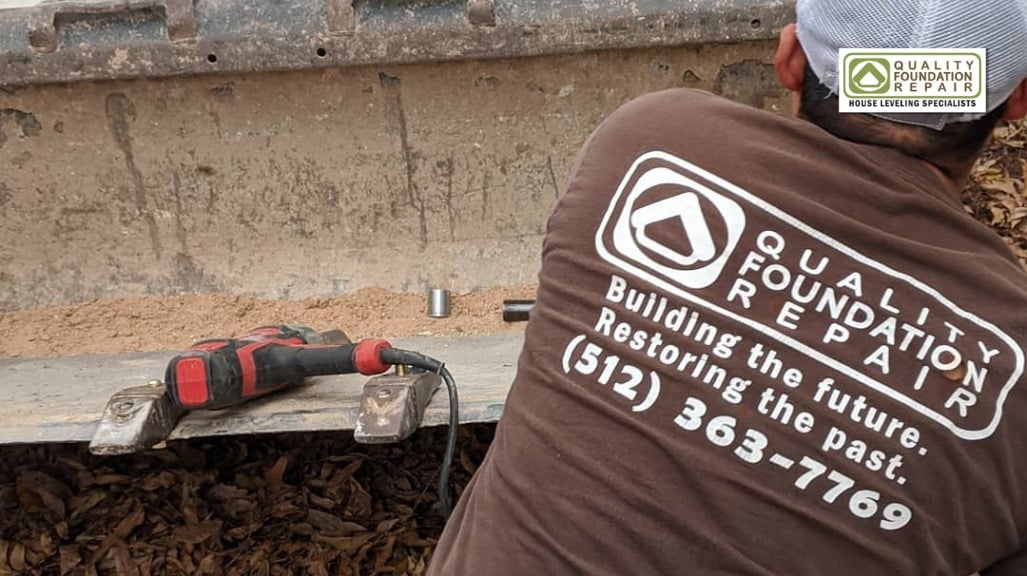
For a settled slab, we install steel push piers, which we manufacture in-house. The piers are driven through the unstable surface clay down to firm bearing soil, transferring the weight of the house off the clay and onto the piers. As each pier is driven, a pressure gauge on the press tells us when it has reached firm bearing.
Once the piers are set, hydraulic jacks lift the slab to its maximum practical level and each pier is welded to the bracket supporting the foundation.
You will see other slab methods discussed online, including foam injection and concrete piers. Quality Foundation Repair Austin does not use those. We build our repairs around steel push piers because they suit the expansive clay profile across Central Texas and because manufacturing them ourselves means we control the material going under your home.
Pier-and-Beam Foundations
Pier-and-beam construction sits the house on piers with beams spanning between them and floor joists laid across the beams. The result is a crawl space between the soil and the underside of the house, which is genuinely useful: it gives access to plumbing and wiring, and it keeps the structure up off the ground.
How Pier-and-Beam Foundations Get Leveled
Pier-and-beam leveling usually involves more than lifting. Beams and joists that have taken on moisture may have rotted and need replacing before anything gets raised, and rotted wood shims or deteriorated original piers need to come out.
For support we install Adjust-A-Piers. The key advantage, and the reason we chose this system, is in the name: they can be adjusted later. Central Texas soil does not stop moving after a repair. If the house shifts again in five years, an adjustable pier can be brought back into position without starting over.
Girders under the structure are raised at the support points with hydraulic jacks, slowly and in stages, so the structure is not asked to move faster than it can handle.
Do You Need Foundation Repair or House Leveling?
In practice the two overlap. Stabilising the foundation stops further movement; leveling brings the structure back toward flat. Which one your house needs, and whether it can safely take a lift at all, depends on what is actually happening underneath.
That is not something you can determine from inside the house. It takes an inspection, and in some cases a structural engineer's assessment or a slab survey to map the elevations across the floor.
This Is Not a DIY Project
Leveling a house means moving many tons of structure in a controlled way. Lifting unevenly, or too fast, cracks walls, warps door frames, and snaps plumbing lines. The repair bill for that is considerably larger than the original problem.
If you have noticed sagging floors, cracks opening in walls or ceilings, or doors and windows that have stopped lining up, the useful first step is an inspection that tells you what is causing it. Book a free inspection and we will tell you what we find, including if the answer is that your house does not need work yet.
Common Questions About House Leveling
Is It Worth Leveling a House?
When there is genuine differential settlement, yes. The movement does not reverse on its own, and the secondary damage from it, cracked drywall, sticking doors, separated trim, keeps accumulating until the foundation is stabilised.
What Does House Leveling Cost?
It depends on the foundation type, the size and condition of the house, how far it has moved, how many support points it needs, and what caused the movement in the first place. Anyone quoting a figure before looking at your house is guessing. An inspection and a written estimate is the only way to get a number that means anything.
How Is a House Actually Lifted?
Access points are opened at the foundation, piers are installed to firm bearing, and hydraulic jacks raise the structure in controlled stages while elevations are monitored across the house. It is slow and deliberate work, which is the point.
How Can I Tell If My Foundation Has Moved?
- Check the grade. Soil around the perimeter should slope away from the house. If it is flat, or water ponds near the foundation after rain, drainage is working against you.
- Look at the walls. Long vertical cracks, and stair-step cracks in brick or stone, are the classic signs of settlement.
- Watch the doors. Doors and windows that used to close cleanly and now stick or leave gaps are telling you the frame has moved.
- Check the crawl space. On a pier-and-beam home, a laser level under the house will show you how far out of level the floor structure has gone.
Drainage is worth taking seriously on its own. Foundation repair that ignores the moisture driving the movement is an incomplete repair, which is why we look at how water moves around your home as part of any inspection.